Loading page
Each safety style states its EN ISO rating
Each safety style states its EN ISO rating
S1P, S3, S7S: the codes on a safety boot tell you exactly what it protects you from, once you know how to read them. This guide walks the EN ISO 20345 rating ladder in plain English, and each style we sell states its own rating on its page, so you can match the rating to the job and buy with confidence.
Every rating starts with a toe cap tested to a 200 joule impact. S1 adds an antistatic build, an energy-absorbing heel and a fuel-resistant outsole.
S1P adds a penetration-resistant midsole to the S1 package, the usual choice for dry indoor work and lighter site duties.
S3 adds a water-resistant upper and a cleated outsole on top of midsole protection. If in doubt on a UK site, S3 is the safe call.
The 2022 standard added S7 classes for whole-boot water resistance, plus S1PS, S3S and S3L markings for the newer midsole tests.

Boots · SJ-BESTBOY

Shoes · SJ-ECOFITZS1P

Boots · SJ-MODULOS3M
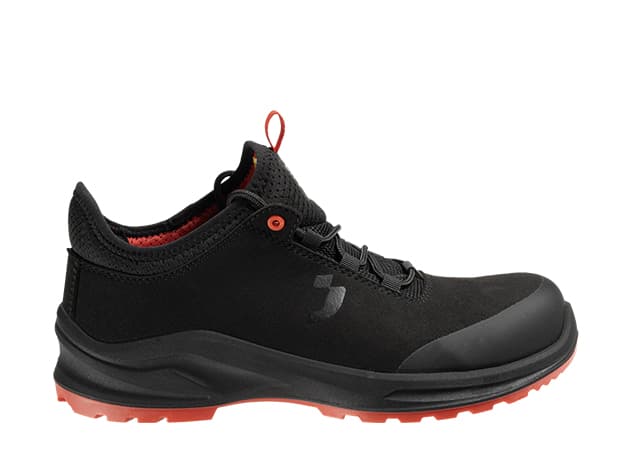
Shoes · SJ-MODULOS3L

Shoes · SJ-CADOR

Boots · SJ-SAFETYBOY

Shoes · SJ-MODULOS1PS

Boots · SJ-DAKAREWS3

Shoes · SJ-MODULOS1PL

Shoes · SJ-BESTRUN

Trainers · COFRA-36390

Boots · COFRA-36386

Trainers · COFRA-36385

Boots · SJ-SAFETYSTAR

Boots · COFRA-36388

Trainers · COFRA-36383

Boots · COFRA-36395

Boots · COFRA-36384

Boots · SJ-MODULOS3MT

Shoes · SJ-X0600

Boots · SJ-MAYONS3S

Boots · COFRA-36393

Boots · SJ-BESTBOYMF

Shoes · SJ-MODULOS3LT
Safety footwear ratings under EN ISO 20345 are cumulative: each step up the ladder keeps everything below it and adds more. SB is the baseline, a toe cap that withstands a 200 joule impact. S1 adds a closed heel, an antistatic build, an energy-absorbing seat region and a fuel and oil resistant outsole. S2 adds a water-resistant upper on top of that, and S3 adds a penetration-resistant midsole and a cleated, grippy outsole. That is why S3 has become the default spec on UK construction sites: it covers impact, puncture, wet ground and slips in one certificate.
The 2022 revision of the standard refined how midsoles are tested. Where the old P marking always meant a steel plate, the newer certificates distinguish the material: a letter S after the rating (as in S1PS or S3S) means a metallic insert, while an L (as in S3L) means a non-metallic insert tested against a finer nail. In practice both protect your sole; the non-metallic versions are lighter, flex more freely and do not conduct heat or cold. If you want to avoid metal in the boot entirely, our metal-free safety boots collection gathers the fully non-metallic options.
The 2022 standard also introduced S6 and S7 for whole-boot water resistance. A water-resistant upper (the S2 and S3 requirement) keeps splashes and surface water out; a fully water-resistant boot (S6 or S7) is tested so the whole boot keeps water out, which matters for groundworks, agriculture and anyone standing in standing water. S7S and S7L follow the same midsole lettering as above. You will find these alongside membrane-lined S3 styles in our waterproof safety boots collection.
Choosing is simpler than the codes suggest. Dry indoor trades are well served by S1P trainers and shoes. General UK site work points to S3 safety boots. Wet ground, winter groundworks and farming point to S7 or a membrane-lined S3. Slip markings (SR on newer certificates, SRA, SRB and SRC on older ones) tell you the sole passed slip testing, worth checking for smooth or greasy floors. Whatever the rating, fit decides whether you will actually wear them all day, and our size and fit guide covers length, width and lacing.