Buying guide
Metal free safety footwear
What does metal free safety footwear mean, and do I need it?
The short answer
Metal free means every part of the boot that would normally be metal is not: the toecap, the penetration-resistant midsole and usually the eyelets too. The protection is identical, because a metal free boot passes the same 200 joule toecap test and the same midsole penetration test as a steel one. Buy it if you go through metal detectors daily at an airport, a secure site or a prison, if you work near metal detection equipment in food production, if you work in cold stores or near heat where steel conducts temperature straight into the boot, or if you need non-magnetic footwear. Watch for one common trap: a boot with a composite toecap can still have a steel midsole, and that will still set off a detector. Look for 100% metal free, or for the class code S1PS, S1PL, S3S or S3L, which tell you the midsole is non-metallic too.
What has to be non-metallic
A safety boot has three places metal traditionally lives. Take metal out of all three and the boot is metal free.
A glass fibre, carbon or plastic composite cap, tested to the same 200 joules and 15 kN as steel. This is the part most people know about, and on its own it is not enough.
The layer that stops a nail coming up through the sole. In the class code it appears as PL or PS, or as S1PL, S1PS, S3L and S3S. This is the part people miss.
Lace eyelets, hooks and any buckle. Small parts, but enough to trigger a sensitive detector, which is why a genuinely metal free boot changes them too.
The trap: composite toecap does not mean metal free
Plenty of boots pair a composite toecap with a steel midsole, and the marketing leads with the composite. If your reason for buying is a metal detector, that boot will fail you every morning. Check for a stated 100% metal free construction, or read the class code: the S, L, PS and PL letters are what tell you the midsole is non-metallic.
Where metal free earns its money
Airports, secure sites, prisons, courts
Screening every entry, several times a day, is a genuine daily tax on your time and everyone else's. This is the most common reason people buy metal free, and the easiest to justify.
Food production and processing
Lines with metal detection and sites with strict foreign-body controls. Some sites specify it outright, and a wash-down environment also suits a cap that cannot corrode.
Cold stores and winter outdoor work
Steel conducts, so a steel cap draws heat out of your toes and pulls cold in. Non-metallic caps do neither, which is why cold store teams tend to end up in them whatever else they need.
Foundries, welding, hot work
The same conduction argument in reverse. Pair it with a heat-resistant outsole, marked HRO, for contact with hot surfaces.
Non-magnetic environments
Strong magnetic fields and sensitive instrumentation. Where an MRI suite is involved, clear the footwear with the site's MR safety officer rather than relying on a product description, because their rules are stricter than any product label.
Anyone who wants the lightest boot
Non-metallic components are lighter than the steel ones they replace. Over a full shift on your feet, that is the difference people notice first.
What metal free does not mean
- It does not mean less protection. The toecap and midsole tests are the same tests, passed to the same figures.
- It does not mean electrically insulating. If you need protection from electrical hazard, specify that separately rather than assuming a metal free boot provides it.
- It does not mean antistatic or ESD. Antistatic is built into S1 and above, and ESD is a separate, tighter specification. A boot can be metal free without being ESD rated.
- It does not mean the boot is lighter in every respect. The sole unit, the leather and the build all matter more to the total weight than the cap does.
How to check a boot really is metal free
- 1Look for a stated 100% metal free construction on the product page rather than the word composite on its own.
- 2Read the class code. S1PS, S1PL, S3S and S3L all tell you the penetration-resistant midsole is non-metallic. A plain S1P or S3 uses a steel plate.
- 3Look at the eyelets in the photographs. Metal eyelets on an otherwise metal free boot are the giveaway.
- 4If the site's requirement is strict, ask us before you order and we will confirm the specification with the manufacturer. That is quicker than a rejected delivery.
Metal free footwear available now
Non-metallic toecap and midsole, so nothing in the boot for a detector to find.

Wellingtons · MUCK-41314
Grit S5 Safety Wellington

Boots · SJ-MODULOS3M
Modulo S3S Mid
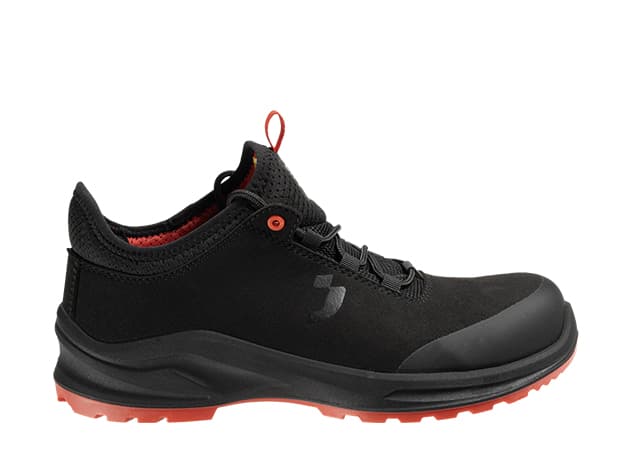
Shoes · SJ-MODULOS3L
Modulo S3S Low

Shoes · SJ-MODULOS1PS
Modulo S1PS Sandal

Shoes · SJ-MODULOS1PL
Modulo S1PS Low Perf

Wellingtons · MUCK-41315
Grit S5 Safety Wellington (Women's)

Boots · COFRA-36386
Funk S3 SRC Safety Boot

Trainers · COFRA-36385
Rap S3 SRC Safety Trainer

Trainers · COFRA-36383
Caravaggio S3 SRC Safety Trainer
Common questions
What does metal free safety footwear mean?
It means the toecap, the penetration-resistant midsole and usually the eyelets are all non-metallic, so there is no metal in the boot at all. The protection is unchanged: a metal free boot passes the same 200 joule toecap test and the same midsole penetration test as a steel-toed one.
Will metal free boots set off a metal detector?
No, that is the point of them. The caveat is that a boot with a composite toecap is not necessarily metal free, because it may still have a steel midsole or metal eyelets, and either of those will trigger a detector. Look for a stated 100% metal free construction or for class codes like S1PS, S1PL, S3S and S3L that confirm the midsole is non-metallic.
Are metal free safety boots as safe as steel toecap boots?
Yes, in the terms the standard measures. Both have to withstand a 200 joule impact and 15 kN of compression at the toe, and the non-metallic midsole is tested against a nail just as a steel plate is. Steel does have two practical advantages: the cap is thinner, so there is more room inside the same size, and it copes slightly better with repeated heavy knocks.
Are metal free boots better in cold weather?
Yes. Metal conducts, so a steel toecap draws heat away from your toes and transmits cold in from outside. Non-metallic caps do not, which is why cold store and winter outdoor workers usually prefer them. For serious cold, pair that with the CI marking, which is cold insulation tested through the sole.
Do I need metal free boots for food production?
It depends on the site. Where there is metal detection on the line or a strict foreign-body policy, many sites specify it, and the wash-down environment also suits a toecap that cannot corrode. Check your site's PPE policy first, because requirements vary between processors.
Does metal free mean the boots are electrically safe?
No. Metal free is about detectors, temperature and weight. Protection against electrical hazard is a separate specification and should be asked for by name. Antistatic and ESD are also separate: antistatic is built into S1 and above, and ESD is a tighter requirement on top.
Keep reading
Still not sure which pair?
Answer five questions about your work and we will narrow the range down to the styles that suit it. Or call us and talk it through with someone who knows the catalogue.