Buying guide
Composite or steel toecap?
Is a composite toecap as safe as a steel one, and which should I buy?
The short answer
Both pass exactly the same test, 200 joules of impact and 15 kN of compression, so neither is safer at the toe. Choose composite if you go through metal detectors, work in the cold or near heat, or want the lightest boot, because composite does not set off detectors and does not conduct temperature into the boot. Choose steel if you want more room inside the same size, because a steel cap is thinner than a composite one, and if you want the toughest resistance to repeated knocks at the lowest cost. If you are between sizes in a composite boot, try the half size up, since the bulkier cap takes up room a steel cap does not.
They pass the same test
This is the part most comparisons bury. Under EN ISO 20345 a toecap has to withstand a 200 joule impact and 15 kN of compression, whatever it is made of. A cap that fails is not certified and cannot be sold as safety footwear. So the honest position is that the material is a comfort, environment and cost decision, not a protection decision. Our guide to the rating letters explains what else the rating covers.
The comparison, side by side
| Steel | Aluminium | Composite | |
|---|---|---|---|
| Protection rating | 200J | 200J | 200J |
| Weight | Heaviest | Middle | Lightest |
| Sets off a metal detector | Yes | Yes | No |
| Conducts heat and cold | Yes | Yes | No |
| Room inside the boot | Most, the cap is thinnest | Similar to steel | Least, the cap is bulkier |
| Repeated heavy knocks | Excellent | Can dent without shattering | Very good, can crack under extreme repeat impacts |
| Rust and corrosion | Can corrode if the cap is exposed | Resists corrosion | Cannot corrode |
| Cost | Least costly | Middle | Most |
Buy composite if any of these are true
- You pass through a metal detector regularly. Airports, secure sites, prisons, courts, some data centres and any food factory with metal detection on the line. This is the single most common reason people switch, and it is the one that saves time every single day.
- You work in the cold. A steel cap pulls heat out of your toes because metal conducts. In a cold store or on a winter site, composite makes a difference you can feel by the end of a shift.
- You work near heat. The same conduction works in reverse near hot surfaces and metal splash.
- You want the lightest boot you can get. Composite is the lightest of the three materials, and over a long shift that adds up.
- The boots get soaked constantly. A composite cap cannot corrode.
Buy steel if any of these are true
- Your toes feel cramped in composite boots. Steel is strong enough to be formed thinner, so a steel cap leaves more room inside the same size. If you have wide feet or deep toes, this is a real advantage. Our {0} goes further on fit.
- The boot takes constant heavy knocks. Both materials are certified, but steel is the more forgiving of the two under repeated abuse.
- You are buying for a team on a budget. Steel is the least costly of the three, and across twenty pairs the difference is worth having.
- Nothing on the composite list applies to your work. There is no prize for paying more for a property you will never use.
The fit trap nobody mentions
A composite cap is bulkier than a steel one, so the same nominal size can feel tighter across the toes in a composite boot than in a steel one. If you are moving from steel to composite and you are between sizes, go up the half size rather than assuming the brand has changed its sizing.
Three myths worth killing
- 1"Composite is not as strong." Both pass the same 200 joule and 15 kN tests. If a cap did not pass, the boot would not be certified.
- 2"Steel can cut your toes off." This one has been circulating for decades on the back of a story that never happened. The cap is designed to deform and absorb energy, and it is tested to do exactly that.
- 3"Metal free means electrically safe." It does not. Metal free is about detectors, temperature and weight. Electrical protection is a separate specification, and if you need it you should be specifying it explicitly rather than inferring it from the toecap.
After a serious impact, replace the boot
This applies to both materials. A cap that has taken a heavy blow has done the job it was designed to do once, and it can be deformed or cracked in ways you cannot see from the outside. If something substantial lands on your foot, retire the pair rather than trusting it to work a second time.
Composite toecap footwear available now
Metal detector friendly, lighter, and no temperature conducted through the cap.

Wellingtons · MUCK-41314
Grit S5 Safety Wellington

Boots · SJ-MODULOS3M
Modulo S3S Mid
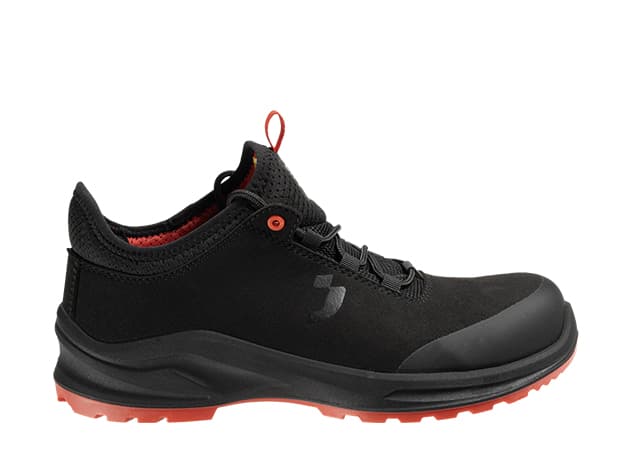
Shoes · SJ-MODULOS3L
Modulo S3S Low

Shoes · SJ-MODULOS1PS
Modulo S1PS Sandal

Shoes · SJ-MODULOS1PL
Modulo S1PS Low Perf

Wellingtons · MUCK-41315
Grit S5 Safety Wellington (Women's)
Steel toecap footwear available now
More room inside the same size, and the toughest option on repeated knocks.

Boots · SJ-BESTBOY
Bestboy

Boots · SJ-SAFETYBOY
Safetyboy

Boots · SJ-DAKAREWS3
Dakar Ew S3

Boots · SJ-SAFETYSTAR
Safetystar

Boots · GB-40687
Sawhorse 2.0

Boots · COFRA-36388
Land BIS S3 SRC Safety Boot
Common questions
Is a composite toecap as strong as steel?
For the purpose the standard measures, yes. Both have to withstand a 200 joule impact and 15 kN of compression to be certified to EN ISO 20345, and a cap that fails those tests cannot be sold as safety footwear. The differences between the materials are weight, temperature conduction, metal detection, bulk and cost, not the level of protection.
Will composite toecap boots set off a metal detector?
The toecap will not. A boot described as 100% metal free has a non-metallic toecap, a non-metallic midsole and non-metallic eyelets, so there is nothing ferrous in it to detect. Be careful with boots that have a composite toecap but a steel midsole, which is a common combination: the toecap passes, the midsole does not.
Which toecap is better in cold weather?
Composite. Steel conducts, so a steel cap draws heat away from your toes in a cold store or on a winter site, and it transmits cold in from outside. A composite cap does neither, which is why cold store workers usually end up in composite boots regardless of what else they need.
Do composite toecaps make the boot fit smaller?
Slightly, yes. A composite cap has to be a little thicker than a steel one to hit the same test figures, so it takes up more room inside the same shell. If you are moving from steel to composite and find your usual size tight across the toes, try the half size up before deciding the brand runs small.
Are composite toecap boots more expensive?
Usually a little, yes. Steel is the least costly of the three materials, aluminium sits in the middle and composite is the most. The gap is small on any individual pair and matters most when you are buying for a whole team.
What about aluminium toecaps?
Aluminium sits between the two. It is lighter than steel and has a similarly thin profile, so it keeps the room inside the boot, but it still conducts temperature and it still sets off metal detectors. It also dents rather than shattering under extreme impact. It is less common in the UK than steel or composite.
Keep reading
Still not sure which pair?
Answer five questions about your work and we will narrow the range down to the styles that suit it. Or call us and talk it through with someone who knows the catalogue.